Stranger Things - Vecna
As a look development artist for Netflix's Stranger Things (Season 4), I worked on the creature Vecna.
The main challenge was creating the slithering tentacles covering his body. We achieved this using a technique similar to rivers in real-time projects—shifting UVs with a flowmap generated by FX, which was looped and controlled in shading. The lighting department could then adjust the speed of the tentacles using exposed attributes, tailoring the effect to suit the mood of each shot.
Beyond the tentacles, the goal was to match and enhance the costume originally created by the makeup department. The creature was first modeled by the Rodeo FX team and then sent to the makeup department, where the parts were 3D printed and fitted to the actor. This adjusted costume was scanned using photogrammetry and sent back to the modeling and texturing teams for precise matching.
Because Arnold’s subsurface model doesn’t account for bump maps, I worked on adding displacement from bump maps along with fine noise patterns. This ensured accurate subsurface scattering and better specular reflection, creating a more realistic and detailed look for the character.
Big shootout to my colleagues Diego Romo, who did a fantastic texturing job and Philip Harris-Genois who modeled Vecna and supervised the work between all our departments.

Vecna, the main vilain of Stranger Things Season 4
The main challenge were the silthering tendrils. The effect was achieved by shifting UVs with a flowmap generated by FX, which was looped and controlled in shading.

Vecna's first appearance in the show. I built a pre-lighting pass in order to see if the surface of the asset was behaving consistently with the live shot. This allowed us to notice that they sprayed the actor before filming a scene to give a wetter look.
A close up turntable of Vecna with a lighting matching closely the reference shoot.
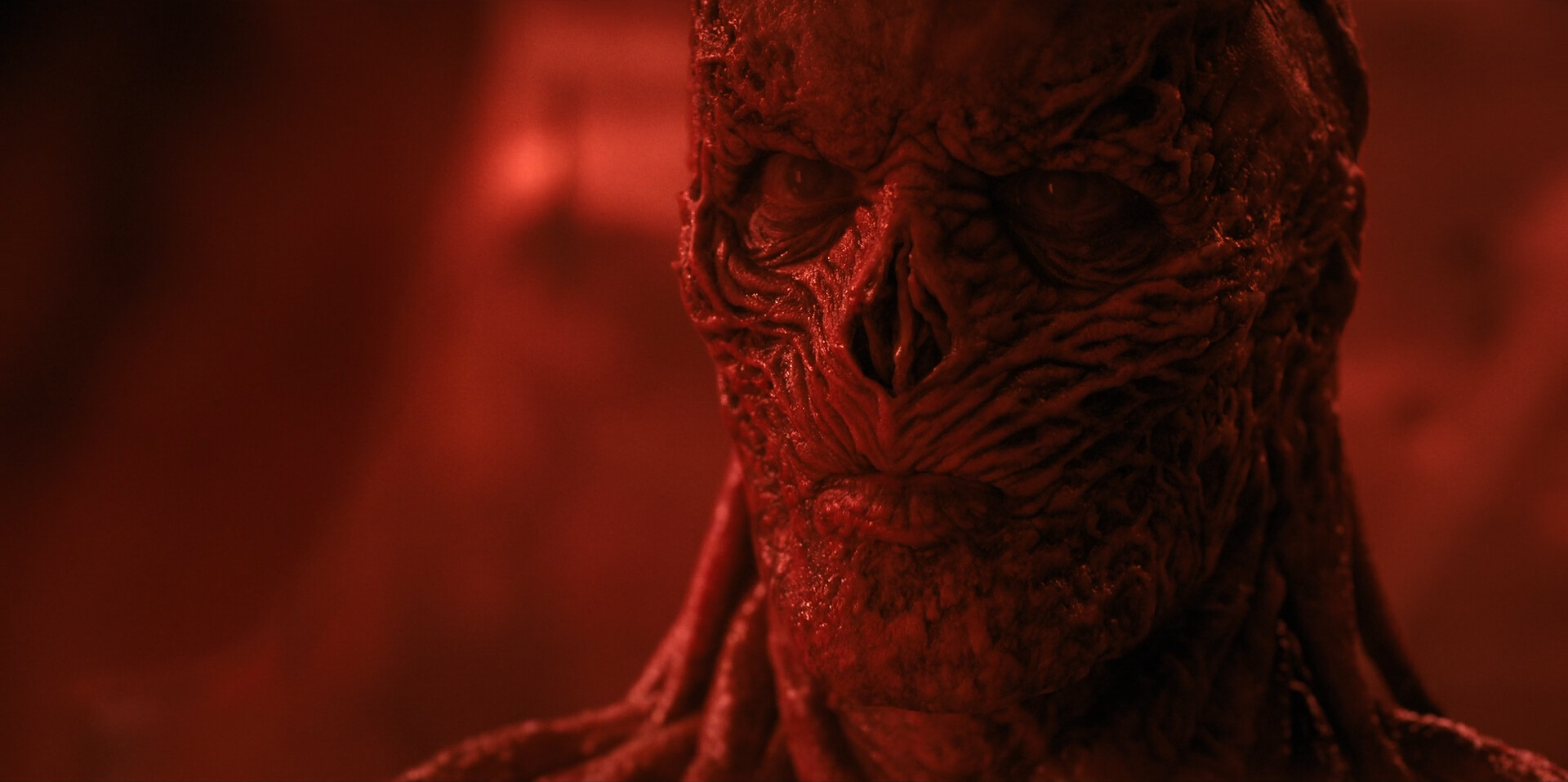
Close up of Vecna in his Mind Lair.
The tentacles that enter Vecna's back and suspend him in the air. Earlier designs used to have the slithering effect but were discarded in favor of the teeth-like ends.

Vecna's in the upside down. In a lot of shots 95% of Vecna got replaced by the CG version.

The concept art of Vecna by Michael Maher Jr, that got used as references.